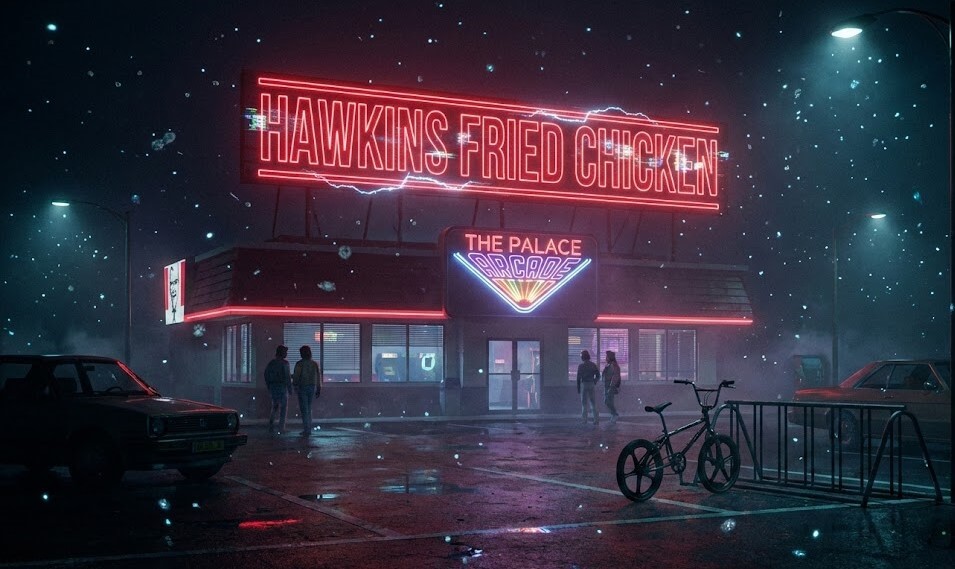
If 2025 taught marketers anything, it’s that audiences are craving immersion. In a world dominated by AI-generated content and algorithmic feeds, tangible, real-world experiences have become the new luxury. While brands like Nike shifted towards quiet introspection and mental health in their recent rebrand, fast-food giant KFC decided to take us on a loud, neon-soaked trip to another dimension.
Coinciding with the highly anticipated release of Stranger Things Season 5 on Netflix, KFC launched its most ambitious global campaign to date: the temporary rebranding of its flagship stores into “Hawkins Fried Chicken” (HFC).
This wasn’t just a limited-time menu; it was a total brand takeover that blurred the lines between fiction and reality. In this extensive case study, we will dissect the strategy, the execution, and the psychology behind why “HFC” became the viral moment of late 2025 and early 2026.
1. The Concept: Total Narrative Integration
Most brand collaborations are superficial. A logo on a cup, a toy in a Happy Meal. KFC went deeper. They didn’t just partner with Stranger Things; they became part of the show’s lore.
The premise of the campaign is meta-fictional: “In 1986, Colonel Sanders visited Hawkins, Indiana, and left a secret recipe in the Upside Down.”
By creating a fictional backstory that fits seamlessly into the show’s 1980s timeline, KFC bypassed the consumer’s natural defense against advertising. Fans didn’t see it as a commercial; they saw it as “bonus content” for the show they love. This is a crucial lesson for modern marketers: Don’t interrupt the entertainment; BE the entertainment.
2. The “Viral” Video Ad: Deconstructing the Teaser
The campaign kicked off with a 60-second spot that currently has over 50 million views on YouTube. Let’s break down the cinematic techniques used.
(Note: Link represents the official campaign teaser)
Scene-by-Scene Analysis
- 0:00-0:15: The ad opens with static grain and synth-wave music. We see a classic 1980s KFC family bucket on a dinner table. Everything feels normal, warm, and nostalgic.
- 0:16-0:30: The lights in the room start to flicker (a key motif from the show). The Colonel Sanders logo on the bucket begins to distort. His smile twists into something more sinister.
- 0:31-0:45: The “Upside Down” takes over. Vines and spores float through the air. The chicken pieces turn pitch black (using squid ink batter). The tagline appears: “Finger Lickin’ Good… in Every Dimension.”
- 0:46-1:00: The reveal of the “Demogorgon Burger”—a spicy chicken sandwich with black buns and red chili jam “blood.”
Unlike Spotify Wrapped’s focus on personal data visualization, this ad relied on collective cultural nostalgia. It tapped into the shared memory of the 80s aesthetic that Stranger Things has popularized for the last decade.
3. Immersive Experiential Marketing: The “Pop-Up” Strategy
Digital ads are easy to ignore. A 20-foot Demogorgon on top of a KFC restaurant is not.
KFC transformed 15 flagship locations in major cities (London, Tokyo, New York, São Paulo) into “Hawkins Fried Chicken” diners. The level of detail was obsessive:
- Staff Uniforms: Employees wore 1980s polyester uniforms with retro name tags.
- Menu Boards: Replaced with vintage CRT monitors showing static interference.
- Sound Design: The in-store playlist was strictly 80s hits, occasionally interrupted by “emergency broadcasts” from Hawkins National Laboratory.
The “Ticket” Effect:
People queued for hours. Not for the food, but for the photo opportunity. In the age of Instagram and TikTok, the “shoppability” of an experience is defined by how “grammable” it is. KFC provided a movie set, and the customers became the actors.
4. The Psychology of Nostalgia in 2026
Why does 80s nostalgia still work in 2026? Psychologically, it’s a safety mechanism.
As we face rapid technological changes—from the rise of AI agents to the dominance of spatial computing—consumers subconsciously crave the “simpler times” of the analog era. The 1980s represent a time before smartphones, before constant connectivity, and before digital burnout.
KFC’s campaign cleverly exploits this. It offers a “Comfort Zone”. By eating a retro-styled burger, you aren’t just consuming calories; you are consuming a feeling of safety and familiarity. This contrasts sharply with the forward-looking anxiety addressed in our previous analysis of Nike’s Why Do It campaign, which asks users to confront their internal struggles.
5. Menu Innovation: The “Dare” Factor
Viral food marketing requires a “Dare Factor.” The item must be unique enough that you have to try it, even if just to say you did.
| Menu Item | Description | Viral Factor |
|---|---|---|
| The Void Burger | Charcoal-infused black bun with spicy Zinger fillet. | Visually striking (Black & Red contrast). |
| Eleven’s Waffle Fries | Waffle-cut fries dusted with maple syrup powder. | Direct reference to main character Eleven. |
| The Mind Flayer Shake | Blackberry milkshake with popping candy. | Sensory experience (popping sound). |
6. Strategic Comparison: KFC vs. The Competition
While McDonald’s has focused on “Celebrity Meals” (creating meals based on a celebrity’s favorite order), KFC’s strategy is built on IP (Intellectual Property) Integration.
- McDonald’s Strategy: Relies on the fame of a person (e.g., Travis Scott, BTS). If the celebrity gets cancelled, the campaign fails.
- KFC’s Strategy: Relies on the fandom of a story. Stories are safer assets. They have longer shelf lives and deeper emotional connections.
This move has positioned KFC not just as a fast-food chain, but as a cultural curator. They understand that in 2026, you are competing for attention, not just hunger.
7. Conclusion: The Future of “Eatertainment”
The success of “Hawkins Fried Chicken” proves that the era of passive advertising is dead. To win in 2026, brands must build worlds. They must invite the consumer to step inside, look around, and taste the narrative.
For site owners and marketers reading this: Look at your own brand. You might not have the budget for a Stranger Things partnership, but you can ask yourself: How can I turn my service into an experience? How can I add a layer of story to my product?
As we look forward to the rest of the year, all eyes are now on the upcoming Super Bowl commercials. Will they match this level of immersion? Stay tuned to ReWatchX for our full breakdown next month.
Read More on ReWatchX:
- Data as Art: The Spotify Wrapped 2025 Analysis
- Nike’s “Why Do It?”: The Mental Health Pivot